
What Player Safety Means #
Player Safety is the set of controls designed to protect the participant during a simulation.
Simulations can present the Player with complex, challenging, or emotionally demanding conversations: difficult feedback, sensitive communications, conflicts, commercial pressure, resistance from the interlocutor, anxiety, or relational tension.
For this reason, the platform does not only observe communicative performance, but also monitors whether the experience remains within safe formative limits.
The goal is to distinguish between:
- formative discomfort, i.e., a normal tension that is useful for learning;
- distress beyond the threshold, i.e., signals indicating that the simulation may no longer be safe or appropriate for the Player at that moment.
Formative Stress #
Formative stress is a possible and normal part of learning.
During a simulation, the Player may feel:
- under pressure;
- uncertain;
- challenged by the avatar;
- slightly frustrated;
- emotionally involved;
- tested by a difficult conversation.
This type of stress is not necessarily negative. In many cases, it is precisely what makes the simulation useful: the Player can practice in a controlled environment before facing similar situations in the real world.
Examples of formative stress can include:
- the avatar resists a proposal;
- the avatar shows anxiety, doubt, or skepticism;
- the conversation requires greater clarity;
- the Player must handle an unexpected response;
- the Player must rephrase, slow down, or change strategy.
In these cases, the simulation can continue because the tension remains within an acceptable formative perimeter.
Distress Beyond the Threshold #
Distress beyond the threshold instead indicates a condition in which the system detects more intense or persistent signals of Player discomfort.
The platform does not make diagnoses and does not interpret the Player from a clinical perspective.
The system detects conversational and behavioral signals that, in the context of the simulation, may indicate that the experience is exceeding the intended safety level.
Examples of signals that can contribute to monitoring include:
- strong discomfort expressed verbally;
- signs of emotional overload;
- persistent difficulty in continuing;
- marked increase in tension;
- expressions of stress no longer compatible with normal formative stress;
- repeated signs of blocking, confusion, or loss of control of the conversation.
When these signals exceed the configured thresholds, the platform can automatically interrupt the simulation.
Ethical Thresholds #
Ethical thresholds are safety limits configured to prevent the simulation from becoming excessively stressful, unhelpful, or potentially harmful to the Player.
These thresholds serve to establish when a conversation can continue and when it is preferable to stop it.
Ethical thresholds do not measure the Player’s skill.
They are not a grade, they are not a penalty, and they do not represent a negative evaluation.
They serve to protect the person performing the simulation.
Why Ethical Thresholds are Needed #
Ethical thresholds are important because a realistic simulation can generate pressure.
Without a safety system, a difficult conversation could continue even when the Player shows signs of excessive stress.
The platform instead applies a protection principle:
when Player safety becomes a priority, the simulation is stopped.
This allows the experience to remain:
- formative;
- controlled;
- respectful;
- proportionate;
- consistent with the participant’s well-being.
Monitoring During the Simulation #
During the conversation, the system can monitor signals related to Player safety.
Monitoring serves to understand if the simulation is staying within the intended perimeter.
The system may consider, for example:
- level of conversational tension;
- linguistic signs of discomfort;
- repetition or intensity of critical signals;
- flow of the conversation;
- any indicators of distress;
- consistency between formative difficulty and Player safety.
Monitoring is designed to intervene only when necessary.
Not every difficulty, hesitation, or moment of tension produces a block.
Automatic Simulation Block #
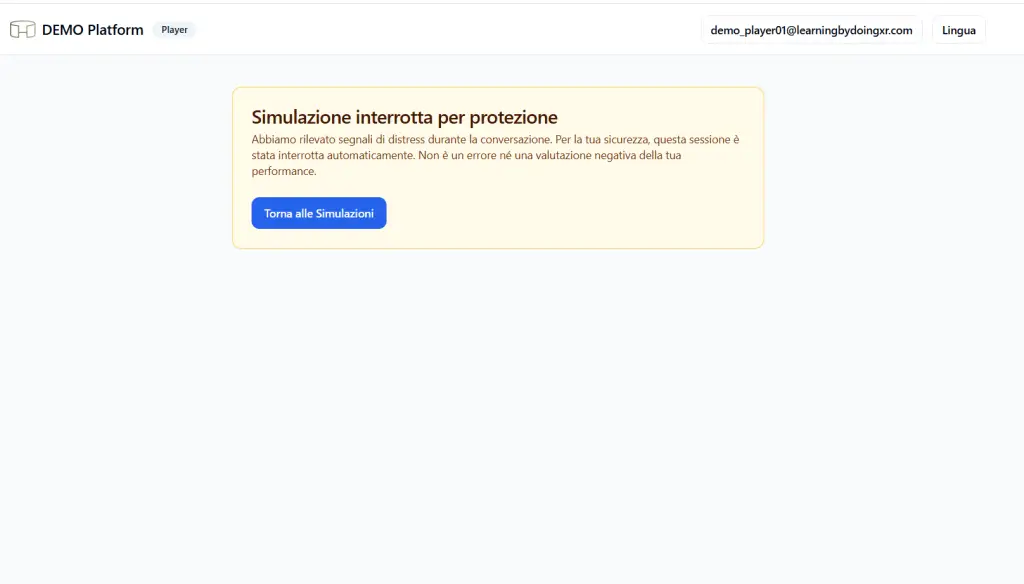
When the system detects signals of distress beyond the configured safety thresholds, the simulation can be automatically interrupted.
In this case, the Player sees a message similar to:
Simulation interrupted for protection
The message explains that:
- distress signals were detected during the conversation;
- the session was automatically interrupted for safety;
- this is not a technical error;
- it is not a negative evaluation of performance.
The Player can then return to the list of available simulations.
What it Means for the Player #
For the Player, an interruption for protection simply means that the platform has prioritized safety.
It does not mean the Player made a mistake.
It does not mean the performance is negative.
It does not mean the simulation was “failed.”
It means that, at that moment, the system detected sufficient signals to stop the experience and protect the participant.
The simulation can eventually be resumed or repeated according to the rules defined by the tenant, the training path, or the number of available attempts.
What Happens to the Report #
When a simulation is interrupted for protection, the readable report may not be generated.
In this case, a message is shown such as:
Report not generated for protection
The report is not produced because the attempt was automatically interrupted for Player protection.
This choice avoids turning a safety interruption into an improper formative evaluation.
The interruption should not be interpreted as a negative score or as an unsuccessful performance.
What the Tenant Admin Sees #
When privacy is active, the Tenant Admin cannot consult individual Player reports.
Interruptions for protection can be shown in aggregate form, for example in runtime reports.
In this aggregate form, the platform can indicate:
- number of protection interruptions;
- interruption rate on the runtime;
- number of distress signals detected;
- maximum tension level in interrupted cases;
- date of the last interruption.
These data do not include individual transcriptions or personal Player content.
They serve to understand if a simulation, as a whole, is generating too many interruptions and might require a revision of the formative design.
Why Interruptions are Useful at the Design Level #
Interruptions for protection do not only serve to protect the individual Player.
They also help Tenant Admins, Providers, and simulation designers understand if a scenario is too intense, unclear, or unbalanced.
A high number of interruptions may indicate the need to review:
- the difficulty level of the simulation;
- the behavior of the Avatar Persona;
- the briefing given to the Player;
- the gradualness of the scenario;
- the pressure exerted by the avatar;
- the safety instructions;
- the type of coaching provided before practice.
In this sense, Player safety is also a tool for the quality of formative design.
Difference Between Conversational Tension and Interruption for Protection #
Not all tension generates an interruption.
In a simulation, the avatar can be resistant, skeptical, anxious, pragmatic, or defensive. This can create conversational tension that is useful for learning.
Tension only becomes critical when the system detects signals that exceed safety thresholds.
In summary:
- formative tension is part of the training;
- formative discomfort can be useful and manageable;
- distress beyond the threshold activates protection;
- simulation block interrupts the experience to protect the Player.
Safety and Evaluation are Separate #
Player safety is independent of performance evaluation.
A simulation can be interrupted for protection even if the Player was communicating well.
Similarly, a simulation can be difficult but not exceed safety thresholds.
For this reason, interruptions should not be used as a direct indicator of competence or incompetence.
The system separates:
- Player safety;
- communicative readiness;
- detected communicative skills;
- Observation Grid results.
This separation allows the participant to be protected without confusing the issue of safety with that of formative evaluation.
Role of the Avatar Persona in Safety #
Avatar Personas can be designed to create different conversational challenges.
Some avatars may be more anxious, resistant, skeptical, or pressuring.
However, even when the avatar portrays a difficult person, its behavior must remain within a safe formative perimeter.
Player safety also serves to prevent a simulation from becoming excessively intense or no longer useful for learning.
The avatar can challenge the Player, but must not turn the experience into an unsustainable situation.
Best practices for the Player #
To get the most out of the simulation, the Player should:
- read the briefing before starting;
- remember that the simulation is a training environment;
- use the available details to orient themselves;
- interrupt or exit the simulation if they do not feel able to continue;
- consider any difficulties as part of the training path;
- not interpret a block for protection as a failure.
Best Practices for Tenant Admins and Training Designers #
To design safe simulations, it is advisable to:
- choose an Avatar Persona consistent with the formative goal;
- avoid unnecessary excessive pressure;
- write clear briefings;
- make the Player’s goal explicit;
- use coaching to prepare for more difficult simulations;
- monitor aggregate interruptions;
- review simulations that generate many interruptions;
- always distinguish between formative discomfort and distress beyond the threshold.
Final result #
Player Safety is a fundamental element of the platform.
It allows for the creation of realistic and challenging simulations while maintaining ethical control over the experience.
The system accepts formative discomfort when it is useful for learning, but intervenes when it detects signals of distress beyond the configured thresholds.
If thresholds are exceeded, the simulation is automatically blocked to protect the Player.
The goal is not to judge the person, but to ensure that the training remains safe, proportionate, and formative.


