
What Avatar Persona Means #
The Avatar Persona is the validated behavioral pattern that defines how the virtual interlocutor behaves during a simulation.
It does not simply indicate the image or visual appearance of the avatar. The Avatar Persona primarily describes the way the interlocutor thinks, reacts, speaks, resists, collaborates, or changes attitude during the conversation.
In other words:
- the visual avatar is the face or appearance the Player sees;
- the Avatar Persona is the behavioral model that guides how that interlocutor acts in the simulation.
An Avatar Persona can represent, for example:
- an anxious person;
- a pragmatic, results-oriented person;
- a passive-aggressive person;
- a skeptical person;
- a person resistant to change;
- an innovative person who pays little attention to risks;
- an emotionally involved person;
- a defensive person under pressure.
They Are Not Improvised Avatars with a Prompt #
Avatar Personas are not avatars created on the fly with a simple free prompt.
This is an important point.
An avatar improvised only through prompts can generate different behaviors from one session to another. It might react inconsistently, change personality, become too collaborative, too aggressive, or interpret the scenario differently for each Player.
In the platform, however, Avatar Personas are designed as stable and validated behavioral patterns.
This means that each Avatar Persona has characteristics defined in advance and maintains behavioral consistency across different sessions.
Why It’s Important to Have Validated Avatar Personas #
Having validated Avatar Personas makes the simulation more reliable, comparable, and educational.
If multiple Players face the same simulation with the same Avatar Persona, they must encounter an interlocutor with a consistent behavioral logic.
This does not mean the avatar always repeats the same phrases.
It means that its way of reacting remains consistent with the expected pattern.
For example, a Business Pragmatic Persona can:
- be results-oriented;
- push for a quick decision;
- fear that controls and processes slow down business;
- accept confrontation if the Player manages to make the risk concrete and manageable;
- become more resistant if they perceive an overly bureaucratic approach.
These characteristics remain stable, even if the conversation changes based on the Player’s responses.
Stability Does Not Mean Rigidity #
A validated Avatar Persona is not rigid or mechanical.
The avatar can adapt to the conversation, respond to the Player, and modify its attitude based on what happens.
The difference is that this adaptation occurs within defined behavioral boundaries.
For example, an anxious avatar can calm down if the Player communicates with clarity, empathy, and gradualness.
A pragmatic avatar can become more collaborative if the Player links the risk to concrete business consequences.
A passive-aggressive avatar can reduce resistance if the Player acknowledges the problem without entering into direct conflict.
The avatar therefore changes, but changes in a way consistent with the persona it represents.
What an Avatar Persona Profile Contains #
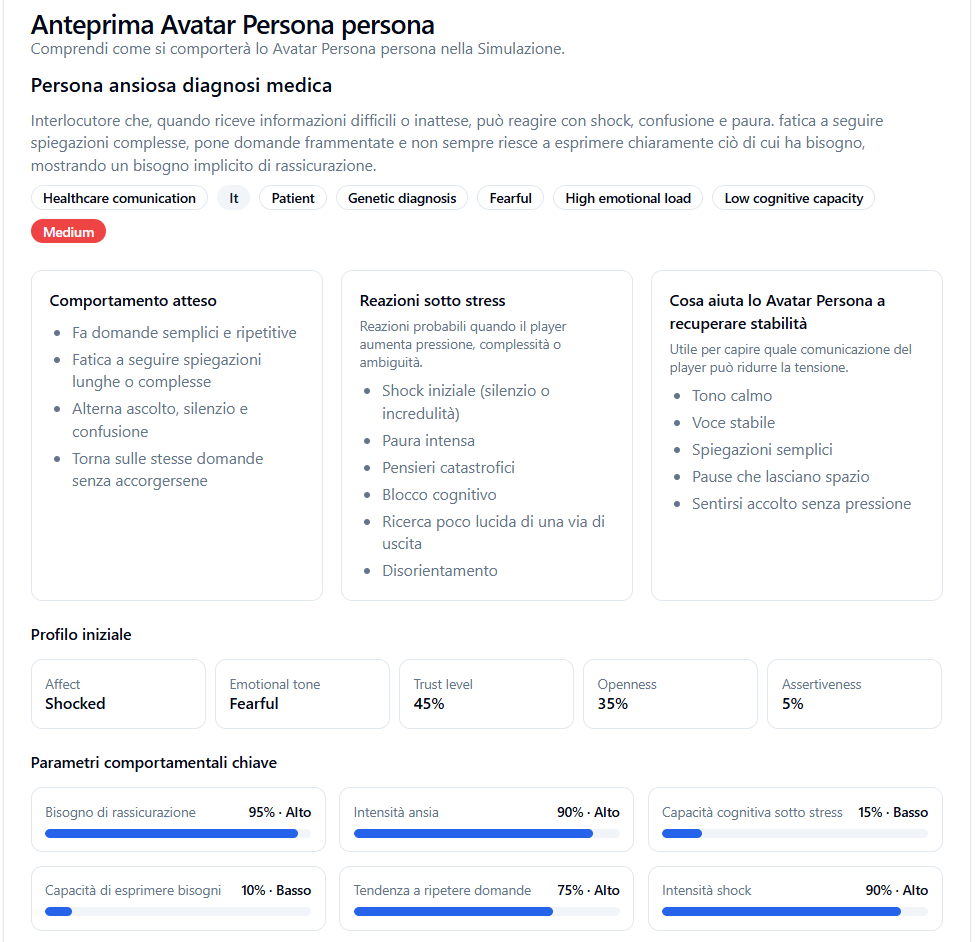
For each Avatar Persona activated by the Provider in the tenant, an information profile can be consulted.
This profile allows the Tenant Admin to thoroughly understand the characteristics of the Avatar Persona before using it in a simulation.
The profile can describe elements such as:
- general profile of the persona;
- prevailing attitude;
- communication style;
- level of openness or resistance;
- baseline emotional tone;
- typical reactions under pressure;
- recurring behaviors;
- elements that increase resistance;
- elements that favor collaboration or openness;
- type of language used;
- main conversational risks;
- educational role of the avatar in the simulation.
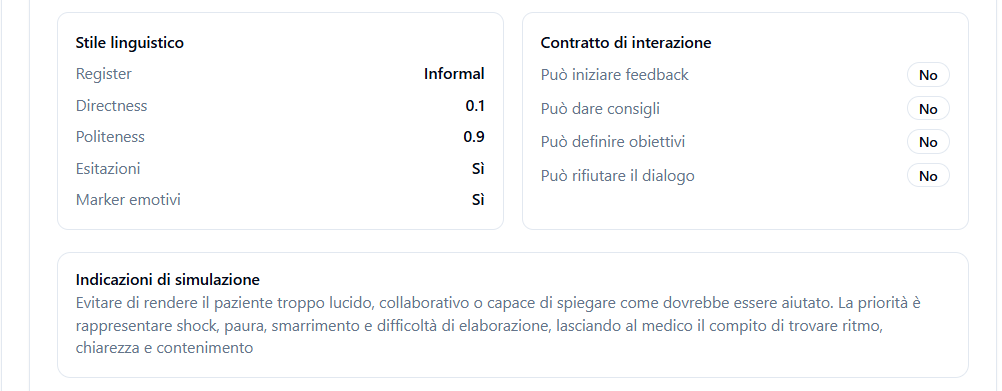
This information helps choose the most suitable Avatar Persona for the scenario.
Example of an Avatar Persona Profile #
Avatar Persona: Business Pragmatic #
This persona represents a senior interlocutor, results-oriented, pragmatic, and pressing.
They consider governance important, but fear that processes, controls, and checks slow down critical business opportunities.
They can react well when the Player:
- acknowledges the value of the opportunity;
- avoids appearing as a bureaucratic block;
- makes risks explicit in a concrete way;
- proposes a viable path;
- distinguishes between what is blocking and what can be managed.
They can react worse when the Player:
- uses an overly rigid tone;
- talks only about rules without connecting them to business;
- does not acknowledge commercial urgency;
- does not propose a next step;
- communicates risk in an abstract or generic way.
Avatar Persona and Simulation #
When creating a simulation, the Tenant Admin selects the Avatar Persona most consistent with the educational objective.
The choice of Avatar Persona influences the type of conversation the Player will experience.
For example, in the same Risk & Compliance simulation, using a pragmatic persona, a skeptical persona, or a passive-aggressive persona can generate very different experiences.
The starting situation can be the same, but the way the interlocutor reacts changes.
This allows training different competencies:
- pressure management;
- listening to objections;
- clarity in communicating risks;
- ability to maintain the relationship;
- adaptation of communication style;
- management of resistance, anxiety, or conflict.
Difference Between Avatar Persona and Avatar Appearance #
It is important to distinguish between Avatar Persona and avatar appearance.
The Avatar Persona defines the behavior.
The avatar appearance defines how the interlocutor appears visually to the Player.
For example, a simulation can use the same Avatar Persona but change visual appearance based on Player access, Web or VR channel, or the configuration chosen by the Tenant Admin.
This allows maintaining stable interlocutor behavior while personalizing the visual experience.
Difference Between Avatar Persona and Voice #
Voice is also separate from the Avatar Persona.
Voice determines the sound of the avatar during the simulation.
The Avatar Persona instead determines its conversational behavior.
This means that the same Persona can be used with different voices, if the Tenant Admin creates different runtime accesses.
Voice can influence the perceived experience, but does not replace the behavioral pattern of the Persona.
Why Avatar Persona Makes Simulations More Comparable #
Validated Avatar Personas make simulations more comparable across different Players.
If the avatar’s behavior were improvised each time, it would be difficult to understand whether the difference in results depends on the Player or on the fact that the avatar behaved differently.
With a stable pattern, however, the system can offer a more consistent experience.
This is important for:
- better evaluating communication skills;
- reading reports more reliably;
- comparing different attempts;
- training multiple Players on the same scenario;
- reducing random variations in interlocutor behavior;
- maintaining more stable educational quality.
Avatar Persona and Educational Safety #
A validated Avatar Persona also helps keep the simulation within safe and consistent boundaries.
The persona can be challenging, resistant, or emotionally intense, but must not step outside the expected role or generate behaviors inconsistent with the educational objective.
This is particularly important in delicate scenarios, such as:
- communicating difficult news;
- critical feedback;
- conflict management;
- conversations about risk and compliance;
- commercial pressure;
- emotionally sensitive situations.
Validation of the behavioral pattern helps prevent the avatar from becoming unpredictable, excessive, or unhelpful for learning.
How to Choose an Avatar Persona #
To correctly choose an Avatar Persona, the Tenant Admin should start from the simulation objective.
Useful questions:
- What type of conversation should the Player train for?
- Should the interlocutor be collaborative, resistant, anxious, pragmatic, or skeptical?
- What communication difficulty do we want to bring out?
- What Player behavior do we want to observe?
- What level of pressure is useful for this simulation?
- Is the avatar’s pattern consistent with the Observation Grid?
The choice of Avatar Persona is not just aesthetic: it is a didactic and design choice.
Usage Examples #
Anxious Persona #
Suitable for simulations where the Player must demonstrate calm, clarity, gradualness, listening, and empathy.
Can be useful in healthcare, care, customer care, or delicate communication contexts.
Business Pragmatic Persona #
Suitable for simulations where the Player must balance results, governance, risk, and decision-making pressure.
Can be useful in managerial, compliance, risk management, or business transformation contexts.
Passive-Aggressive Persona #
Suitable for simulations where the Player must manage indirect resistance, ambiguity, relational tension, and non-explicit communication.
Can be useful in feedback, conflict, difficult collaboration, or team management contexts.
Skeptical Persona #
Suitable for simulations where the Player must build trust, provide evidence, clarify value, and respond to doubts or objections.
Can be useful in commercial, change management, innovation, or training contexts.
How to Read Avatar Persona, Communication Skills, and Observation Grid Together #
The Avatar Persona defines the interlocutor’s behavior.
The Communication Skills define the Player behaviors the system must recognize.
The Observation Grid organizes these skills within the conversation phases.
Therefore:
- the Avatar Persona creates the conversational challenge;
- the Communication Skills define what to observe in the Player;
- the Observation Grid defines when and how to observe those skills;
- the Report shows what emerged in the session.
These elements work together to create a stable, observable, and educational simulation.
Final result #
The Avatar Persona is one of the central elements of the platform.
It allows building consistent, validated, and reusable virtual interlocutors, avoiding each simulation depending on improvised prompts or random behaviors.
Thanks to Avatar Personas, the Tenant Admin can know in advance the behavioral pattern of the interlocutor and choose the one most suitable for the educational scenario.
The Player thus encounters a realistic, dynamic yet stable avatar, capable of reacting to the conversation while maintaining consistency useful for learning.


